Showing posts with label Technology. Show all posts

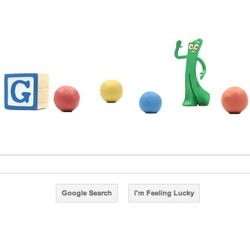
A set of five Google-coloured clay balls spring to life on Google's home page as a tribute to Arthur 'Art' Clokey, a pioneer in the art of stop motion clay animation.
2011-October-Art-Clokey-90th-birthday-Google-Doodle
Past Doodles have at times been interactive such as The Muppets and its creator Jim Henson, what would have been Freddie Mercury‘s 65th birthday, Les Paul the guitar hero and so on.

Born in Detroit, Michigan, Art Clokey began experimenting with stop-motion clay animation in the 50′s. He and his wife created the Gumbasia project, which morphed into the Gumby series. Gumby has remained popular more or less ever since, even spawning a movie as recently as the mid-90′s.

Art Clokey died in 2010 and is remembered today as one of the key figures in American animation. His influence extends to many of the 20th century’s key animators, ranging from the likes of the Czech Republic’s Jan Svankmajer to Britain’s own Tony Hart.

The Gumby Google Doodle features a wooden block for the "G," with clay balls following the Google color scheme sitting in a row, just waiting for you to click and bring them to life. Gumby, in place of the "L," gives a wave when you land on the page, pointing to the clay balls. At the top of the screen, "Art Clokey’s 90th Birthday" links to the search results page for Clokey.

Hovering over each clay ball causes it to compress; moving away releases it to full shape... but when you click on them, they come to life.

Google doodles have gained immense popularity over the past few years and the Google team has put out commemorative doodles on events ranging from news events, civic milestones, birthdays, death anniversaries and important dates in history.

Google estimates it has created more than 900 doodles since 1998, with 270 of them running in 2010 and about 200 in 2011.

On September 24, Muppets creator Jim Henson would have been 75, had he been alive. And in his honor Google has rolled out its latest amazing Doodle a little early.
Google-doodle-tribute-to-Muppet-creator-Jim-Henson
James Maury Henson is best known for ‘The Muppets’ and memorable shows such as Sesame Street, The Muppet Show and films such as The Muppet Movie and The Great Muppet Caper.

Internet search giant Google has created a new interactive doodle that allows users to control digital puppets to celebrate what would have been the 75th birthday of the Muppets creator.

"Become a digital puppeteer today and tomorrow with our homepage tribute to Jim Henson!" Google tweeted.

Google posted a message on its official blog, in which Brian Henson, the chairman of The Jim Henson Company, described his father as a playful, happy, forgiving, visionary and creative figure.

The Doodle is fully interactive with five different muppets on show. Simply use the buttons below each of the muppets to activate their individual animations.
.

The Doodle allows users to become puppeteers through the Google homepage. Six original characters include their own animations including ‘bonus/hidden’ animations which can be discovered by patient Google puppeteers.

The characters were designed at the Henson Company and modeled into a digital puppet in Jim Henson's Creature Shop before being handed over to Google.

The 112th birthday of Jorge Luis Borges, the famed Argentinian author known for his works that explored dreams and unreality, has been celebrated with a colourful Google Doodle
Jorge-Luis-Borges-Google-Doodle-2011-August
Google doodles have gained immense popularity over the past few years and the Google team has put out commemorative doodles on events ranging from news events, civic milestones, birthdays, death anniversaries and important dates in history.

We see many different GOOGLE DOODLEs now which can vary to interactive creations or actual playable games.

Before there was the World Wide Web, the Internet, hypertext markup, or even a digital computer, there was Jorge Luis Borges’ idea of "forking paths." The Argentinean writer who envisioned "a massive branching structure as a better way to organize data and to represent human experience," was born 112 years ago today and is the subject of a special Doodle on Google home page on 24-Aug-2011.

On June 14, 1986 Jorge Luis Borges died of liver cancer aged 86.

His 1941 short story 'The Garden of Forking Paths' is viewed by many as the basis for what we know today as the World Wide Web.

Over the years Google doodles have been commemorating important dates in history. Some of these, including the most recent one for Les Paul was an interactive video.

Japan: Tsunami was observed by radar

Posted by webber | Thursday, August 18, 2011 | , | 0 comments »


For the first time a tsunami has been observed by radar, raising the possibility of new early warning systems. As it swept toward their coasts the tsunami that devastated Japan on March 11 was picked up by high-frequency radar in California and Japan according to U.S. and Japanese scientists.

Scientists in California got an early look at the tsunami generated by the massive earthquake in Japan as it rippled across the Pacific Ocean.

This is the first time a tsunami has been observed by radar, raising the possibility of new early warning systems.

A new radar system could help California brace for the next tsunami.

At least, that is the hope of John Largier, oceanography professor at the University of California, Davis, Bodega Marine Laboratory. In a paper published in the journal Remote Sensing, Largier and co-authors describe how radar detected the March 11 Japan tsunami that also damaged Crescent City and Santa Cruz.

Monsanto Co. (MON), the world's biggest vegetable seed maker, said it will begin selling genetically modified sweet corn in the US this year, the first product it has developed for the consumer market.
Monsanto-genetically-engineered-sweet-corn
The sweet corn seeds are engineered to kill insects living above and below ground and to tolerate applications of the company’s Roundup herbicide, Consuelo Madere, Monsanto vice president for vegetables, told reporters at company headquarters in St. Louis. They will be introduced to growers serving the U.S. fresh corn market starting in the autumn, she said.

Monsanto produces a wide range of seeds and develops biotechnology traits that assist farmers in controlling insects and weeds as well as provides other seed companies with genetic material and biotechnology traits for their seed brands. Now, the company has developed its first product for the consumer market.

The Creve Coeur-based company said the corn would be available in limited markets, but did not specify where. The corn will be sold under the Seminis brand, which Monsanto purchased in 2005.

The company, however, will not use the Monsanto brand to advertise the new line of sweet corn.

Though this is Monsanto's first biotech vegetable launch, Madere said other companies have already brought genetically altered vegetables to market and she did not anticipate significant consumer backlash.

"This is our first launch. We think it is a good product and we'll work to make sure we educate folks to the benefits," she said.

Social Networking and the Digital Natives

Posted by webber | Monday, August 08, 2011 | , , | 0 comments »


Today's teens and college students are what researchers call digital natives, or the iGeneration, a generation constantly connected to the Internet and Facebook, texting and instant messaging.

Parents, who are thinking of ways to secretly monitor their child's social networking, are wasting their time, a new study has suggested.
social-networking-pros-cons-advantages-disadvantages-positives-negatives
Post this, comment on that. Social media are a part of the daily routines of many adults and children. And the identifiable pros and cons of social networking among kids are beginning to emerge, according to a presentation at the American Psychological Association meeting.

The new research suggests that overuse of media and technology can negatively affect health of children and teens, especially with psychological disorders- making users more likely to experience anxiety and depression.

How does a parent best raise a teen growing in a culture of constant communication they just don't understand?
social-networking-pros-cons-advantages-disadvantages-positives-negatives
"Kids are still kids, and kids need parents. Good parenting is linked to everything good all the way though your life," says Larry Rosen, a researcher at California State University and author of "REWIRED: Understanding the iGeneration and the Way They Learn" (Palgrave Macmillan, 2010).

The news is both good and bad, according to Larry Rosen who's been studying the effect of technology on people for more than 25 years. Recently, he's done several studies on how the social networking site affects children.

While teens who use Facebook more often show more narcissistic tendencies, they also have chances to learn how to socialize, particularly shy teens. And while Facebook can be distracting, negatively impacting teen grades, social networking can also provide tools for teaching in compelling ways that engage young students.

An American guy charged with sending more than 27 million spam messages to Facebook users has turned himself in. Sanford Wallace, who is known as the Spam King, surrendered to FBI agents in California.
Facebook-spam-detected-arrested-FBI
Sanford Wallace, 43, was indicted in July by a San Jose, Calif., grand jury on three counts of intentional damage to a protected computer and two counts of criminal contempt, according to the U.S. Attorney's Office in the Northern District of California. Wallace allegedly compromised approximately 500,000 Facebook accounts during three separate attacks on the social-networking giant between November 2008 and March 2009.

Wallace gained fame as one of spam's most vocal defenders back in the 1990s and he has faced numerous civil actions over his activities, including lawsuits from MySpace and the U.S. Federal Trade Commission.

However this is the first time he's facing criminal charges.

Wallace appeared in federal court on Thursday (04-Aug-2011) afternoon and was released on a $100,000 unsecured bond. He was again ordered not to access sites like Facebook and MySpace. He is scheduled to appear in court on August 22.

If convicted of all charges, Wallace could face nearly 40 years in prison and fines of more than $2 million.

In the biggest ever series of cyber attacks uncovered to date, hackers were found to have broken into networks of the Indian government, United Nations and US defence companies, with security experts pointing to China as the culprit.
2011-August-cyberspace-attack-cyberspying
The security company has said it believes there was one "state actor" behind the attacks but declined to name it, though one security expert who was briefed on the hacking told Reuters that the evidence points to China.

Beijing has always denied any state involvement in cyber-attacks, calling such accusations "groundless,"

The company, McAfee, said it had alerted the 72 targets it identified and also informed law enforcement agencies, which it said were investigating. The 14-page report calls the attacks highly sophisticated and says they appear to have been operated by a government body, which it declined to name.

McAfee said that it had come across the extent of hacking in May and had dubbed the uncovering of the plot as ‘Operation Shady RAT’.

In his 14-page report on McAfee's findings, Dmitri Alperovitch, McAfee's vice president of threat research, asserts that Operation Shady RAT may have cost its victims billions in terms of lost revenues and stolen secrets.

"What we have witnessed over the past five to six years has been nothing short of a historically unprecedented transfer of wealth," he said.

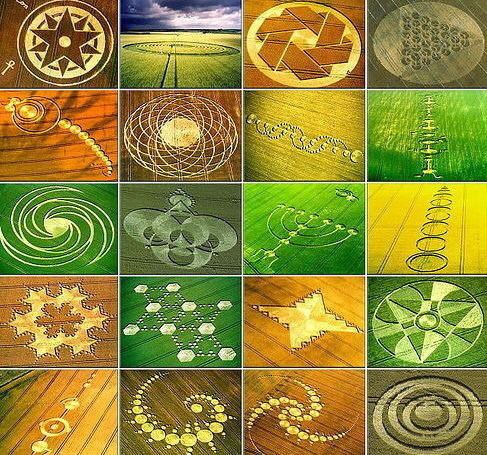
There's no reason to think that Crop Circles are the work of aliens - particularly when human pranksters have already admitted to making them - but they're still mysterious... not to mention a fascinating junction point between physics and art.
crop-circles
Crop circles, elaborate designs that are etched into farmlands that are a thing of beauty when viewed from the air have long been determined to be the work of pranksters.

Crop circles have confounded farmers and scientists alike since they were first recorded in the 17th century, and now physicist Professor Richard Taylor says the phenomenon is growing alongside advances in technology.

Taylor says physics could hold the answer, with crop—circle artists possibly using the Global Positioning System (GPS) as well as lasers and microwaves to create their patterns, dispensing with the rope, planks of wood and bar stools, the journal Physics World reports.

Microwaves, Taylor suggests, could be used to make crop stalks fall over and cool in a horizontal position - a technique that could explain the speed and efficiency of the artists and the incredible detail that some crop circles exhibit, according to an Oregon statement.

And another question -- why does an academic feel the need to get caught up in the world of alien landing conspiracies?

Matin Durrani, editor of Physics World, said Taylor was "merely trying to act like any good scientist -- examining the evidence for the design and construction of crop circles without getting carried away by the side-show of UFOs, hoaxes and aliens."

IE users are dumb, recent study says

Posted by webber | Monday, August 01, 2011 | , , | 0 comments »


If you are yet to ditch Internet Explorer 6, a web browser released in 2001, now is the time to do it. Unless you want to be called dumb.
Internet-web-browsers-online-IE-Firefox-Chrome
Here comes the flame war. According to a new report, dumb people are more likely to use Internet Explorer than smart people.

A survey used tests offered through Web searches or in online ads to measure the IQ of browser users.

  • Internet Explorer users scored lower on online IQ tests than users of other browsers
  • Report says people on the old IE 6 browser scored lowest; Opera users the highest
  • The survey, by a consulting company, wasn't conducted scientifically

It’s also interesting to note that average IQ scores of IE6 users were significantly higher in 2006, and that the IQ scores get better with newer versions of IE.

A company called AptiQuant, a self-proclaimed “world leader in the field of online psychometric testing,” tested the IQs of users and grouped the results according to which browser respondents used.

The survey findings were reported by Jared Newman on PC World with the headline "Internet Explorer Users Are Kinda Stupid" and as his story spread AptiQuant started to receive hate mail from IE users.

Scientists have now taken a major step towards creating artificial intelligence, not in a robot or a silicon chip, but in a test tube.

Researchers at the California Institute of Technology (Caltech) have created a circuit of interacting molecules that can recall memories based on incomplete DNA patterns, just like the human brain.

Supercomputers, robots and the human brain represent the artifacts of a long evolutionary chain stretching back to a soupy mass of molecules floating in Earth's oceans billions of years ago. Now researchers have gone back to the primordial ooze by creating a new type of artificial intelligence based on DNA inside of test tubes.

The neural network is made up of just four artificial neurons, as opposed to the human brain's 100 billion real ones.

To test the network, the scientists played a game with it. That game started with the network being trained to "know" four scientists, each one identifiable by a unique combination of yes/no answers to the same four questions (such as "Is the scientist British?"). Human players then chose one of those scientists, and provided the network with an incomplete set of the identifying answers. They did this by dropping DNA strands that were programmed to correspond to those answers, into water in a test tube that contained the neurons.

Communicating through fluorescent signals, the network would then either correctly identify the chosen scientist, it would indicate that it didn't have enough data to identify just one scientist, or it would state that the data didn't match any of the scientists.

Biochemical systems with artificial intelligence — or at least some basic, decision—making capabilities — could have powerful applications in medicine, chemistry, and biological research, the researchers say.

In the future, such systems could operate within cells, helping to answer fundamental biological questions or diagnose a disease.

The human brain consists of 100 billion neurons, but creating a network with just 40 of these DNA—based neurons — 10 times larger than the demonstrated network — would be a challenge, according to the researchers.

New but tiny moon found orbiting Pluto

Posted by webber | Thursday, July 21, 2011 | , | 0 comments »


Pluto may not have full planet status but the distant, icy rock at the fringe of the solar system has three more moons than Earth. The tiny new moon — announced July 20 and called P4 for now — brings the number of known Pluto satellites to four.

And the find, made with the Hubble Space Telescope, suggests that NASA's New Horizons probe could make some big discoveries, too, when it makes a close flyby of Pluto in 2015, researchers said.

Pluto's largest moon, Charon, is 648 miles (1,043 km) across. The other two, Nix and Hydra, are between 20 and 70 miles in diameter (32 to 113 km), NASA said.

P4 is located between the orbits of Nix and Hydra, both of which were discovered by Hubble in 2005. Charon was discovered in 1978 at the U.S. Naval Observatory.

All four of Pluto's moons are believed to have formed when Pluto and another planet-sized body collided in the early history of our solar system. Earth's Moon may have formed the same way.

P4 was first seen in a photo taken by Hubble on June 28 and was confirmed in subsequent Hubble pictures taken July 3 and July 18, NASA said.

Dawn spacecraft to study origins of Earth

Posted by webber | Monday, July 18, 2011 | , | 0 comments »


NASA's Dawn robotic science probe has entered the orbit around the asteroid Vesta to study the second most massive of its kind in the solar system.

This unmanned NASA probe made history 117 million miles from Earth on Saturday (July 16) when it arrived at the huge asteroid Vesta, making it the first spacecraft ever to orbit an object in the solar system's asteroid belt.

Dawn, which was launched in 2007 by the US space agency, is to offer insights into the beginning of the universe by examining rocky objects that date to the time when planets were forming in the solar system.

The 1.6—metre—long, 747—kilogramme craft was to have begun circling the asteroid Vesta early Saturday. Both Vesta and another Dawn target, the dwarf planet Ceres, are significantly smaller than Earth’s moon.

The probe has taken four years to get to Vesta and will spend the next year studying the huge rock before moving on to the "dwarf planet" Ceres.

Vesta is a huge asteroid about as wide as U.S. state of Arizona, and is also the brightest asteroid in the solar system. It is located in the asteroid belt, a band of rocky objects that encircles the sun between the orbits of Mars and Jupiter.

Asteroid Vesta looks like a punctured football, the result of a colossal collision sometime in its past that knocked off its south polar region.

Using ion thrusters to propel it through interplanetary space, the spacecraft has been sneaking up on Vesta, rather than speeding up and rapidly slowing down. The latter method used by rocket-propeled spacecraft can have catastrophic consequences if the target should be missed. With Dawn's ion drive, if the target is missed, there would have been enough fuel to take another shot at entering orbit.

Interestingly, as the exact mass (and therefore gravity) of Vesta is not known, the exact time of orbital capture cannot be calculated. If the asteroid is more massive, Dawn would have been captured sooner by a stronger gravitational field; if Vesta is less massive, the spacecraft would be captured later by a weaker gravitational field. Until more data is relayed from Dawn, we won't know the precise time of capture.

Mumbai Blasts: CCTV footage being scanned

Posted by webber | Friday, July 15, 2011 | , , | 0 comments »


Maharashtra chief minister Prithviraj Chavan said on Friday (15-July-2011) that investigators are examining forensic evidence and footage from closed circuit televisions for clues about the triple bomb blasts that shook Mumbai and killed 17.

Mumbai Police alongside Maharashtra Anti-Terrorism Squad and the National Investigation Agency (NIA) are investigating all the leads found at the three blast sites to crack the case.

Two days after three blasts rocked the city of Mumbai killing 18 people and injuring 131, the Union Home Secretary RK Singh on Friday (July 15) said that the CCTV footages procured from the three blast sites -- Dadar, Zaveri Bazar and Opera House -- are being probed thoroughly. Though he did not divulge much detail on the blast probe, the home secretary hinted at a possible email trail that is being investigated.

In the absence of any claimants, investigators are now hoping that CCTV footage collected from the three blast sites will provide significant leads.

Video footage captured by more than 46 CCTV cameras is now in the process of being scrutinised by special teams from the crime branch and the Anti-Terrorism Squad (ATS), including experts from central agencies.

As per reports, one camera in Opera House has captured the images of the possible suspects. The footage shows three or four people talking on the phone for over an hour and a half at the same spot.

Moreover, a person carrying a bag is reported to have been identified as a suspect. He is seen moving towards a parked motorcycle and within seconds there is an explosion.

A graduate student from Massachusetts Institute of Technology (MIT) has developed a way to grow humanized liver cells inside mice and thereby potentially increasing the accuracy of drug tests conducted on the animals.
mice-help-drug-test-research
Although scientists commonly use mice for biomedical research, they are not always helpful for pharmaceutical testing. Because mouse livers react to drugs differently than human livers, they often can’t be used to predict whether a potential drug will be toxic to people.

The unique physiology of the human liver means that the toxicity of some candidate drugs is not picked up during preclinical tests in animals. But mice implanted with miniature human livers can mimic the ways in which the human body breaks down chemical compounds, to help spot potential problems before drugs are tested in humans.

To create this artificial liver, researchers at the Massachusetts Institute of Technology in the US cultured human liver cells, called hepatocytes, in a controlled environment with other factors, such as mouse skin cells.

They then implanted the liver under the skin or inside the body cavity of mice, successfully recreating many of the functions of a human liver.

Previous efforts to create such humanized mice have involved injecting human cells into mice with damaged livers. As the human cells repair the damage, they take up residence the liver, but the process takes months to complete and the resulting livers contain a variable proportion of human cells. The new technique takes just a couple of weeks, making it easier for scientists to spot potential toxic side effects of drugs in animal models before moving to human trials, saving money and possibly avoiding unexpected health problems in clinical trials, the authors argue.

Google Doodle is back with a new celebration, internet search giant Google on Tuesday (12-July-2011) marks the 450th anniversary of Moscow's Saint Basil's Cathedral with a commemorative doodle on its home page.

Visitors to Google's home page will see an image of the cathedral integrated into Google's familiar logo.

Clicking on the logo will take the visitor to Google search results for St. Basil's Cathedral.

The Russian Orthodox church sits on Moscow's Red Square just yards from the Kremlin, and its distinctive onion domes have been a backdrop for military parades, concerts, New Year celebrations and Muscovites' wedding photos.

This is not the first time that Google featured the St. Basil’s Cathedral in the search engine’s patented Google Doodles. One of the best St. Basil’s Cathedral Google Doodle was featured on December 24th, 2010 alongside other Christmas-centric buildings, natural wonders and places around the world.

Google can now translate more Indian languages

Posted by webber | Wednesday, June 22, 2011 | , , , | 0 comments »


Internet search engine giant Google on Tuesday (22-June-2011) announced the expansion of its translation services to include five more Indian languages -- Bengali, Gujarati, Kannada, Tamil and Telugu -- thus increasing its reach to a potential half a million population.

With the inclusion of new languages, the total number of languages supported by Google Translate has risen to 63. Google says these languages are presently in experimental phase, noting that Indian languages are pretty different from English language. It also highlights that the new languages supported by its online translation service are spoken by over 500 million people in India and Bangladesh.

According to Google research scientist Ashish Venugopal, Indian languages often use the Subject Object Verb (SOV) ordering to form sentences, unlike English, which uses Subject Verb Object (SVO) ordering.

"This difference in sentence structure makes it harder to produce fluent translations; the more words that need to be reordered, the more chance there is to make mistakes when moving them. Tamil, Telugu and Kannada are also highly agglutinative, meaning a single word often includes affixes that represent additional meaning, like tense or number," Venugopal says.

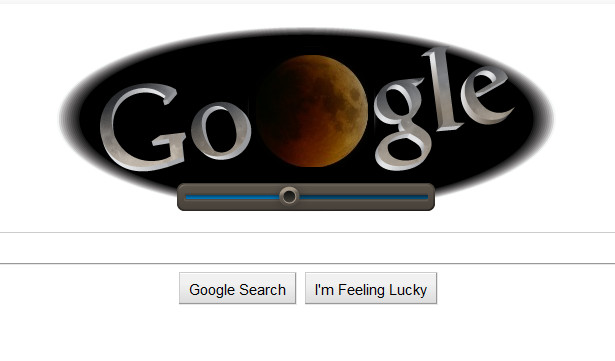
Google put up an interactive Doodle on its homepage to celebrate the June 15 midnight lunar eclipse – the longest and darkest eclipse of the century – where one of its O's was replaced by an almost live image of the moon.
2011-June-Google-Doodle-celebrates-Lunar-Eclipse
The lunar eclipse turned the moon blood red on Thursday (15 to 16-June-2011), yielding a rare visual treat for stargazers across a large swathe of the planet from Australia to Europe.

The first eclipse of the year — when the Earth casts its shadow over the moon — was seen in parts of Europe, Africa, Asia and Australia.

To celebrate the longest total lunar eclipse in 11 years, Google has created this Doodle showing real-time footage of the Earth casting a shadow across the moon.

The live Doodle depicts the 100-minute-long eclipse with footage from around the globe and is reportedly updating every two minutes.

Announcing the new Doodle, a post on the official Google blog reads: "If you visit the Google homepage you’ll see a special interactive doodle, which will update throughout the day to show the latest state of the moon."

Face of Gandhi on Mars..!!

Posted by webber | Monday, June 13, 2011 | , , | 0 comments »


An Italian space buff has claimed to have spotted the face of Mahatma Gandhi etched into the the rocks of Mars while scanning through latest pictures of the Red Planet.

Matteo Lanneo was surveying the amazing pictures sent from Europe's Mars Orbiter back to Earth when he came across this uncanny resemblance to the father of the Indian nation, Daily Mail reported.

The head appears to have a moustache and shaven, and has prominent eyebrows.

Experts say it is not the first time that a face has been seen on Mars's soil.

In July 1976, the American Viking 1 Orbiter took a photograph that appeared to show a hill in the shape of a human face.

Space enthusiasts speculated that the structure was built by aliens.

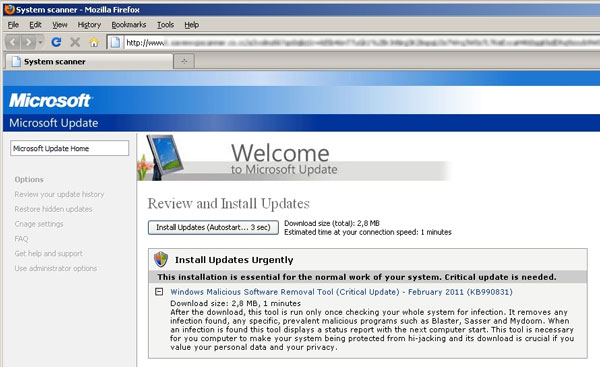
Sophos, the IT security and data protection firm, has released a new warning regarding a fake anti-virus attack. The specialty of this is that it masquerades as Microsoft's security update and tricks the user into installing malicious software.
fake-anti-virus-microsoft-update
According to Sophos, criminals are looking for increasingly convincible ways to persuade consumers to download fake antivirus and copying Microsoft's own security seems to be their latest trap.

"We are seeing the criminals behind fake antivirus continuing to customise their social engineering attacks to be more believable to users and presumably more successful," said Chester Wisniewski on the Sophos blog.

"This week they've started to imitate Microsoft Update." According to Sophos, the drive-by page is an exact replica of the real Microsoft Update page, but only appears on Firefox.

"It only comes up when surfing from Firefox on Windows," said Wisniewski. "The real Microsoft Update requires Internet Explorer."
browser-warning
The use of high quality graphics and professional interfaces means more users are likely to fall for the scam, says Sophos.

"Users need to be more vigilant than ever before, as bogus security alerts pop-up in their browsers," says Graham Cluley, senior technology consultant at Sophos.

Just like visiting one's bank one should only trust security alerts in the browser if one initiated a check with Microsoft, Adobe, Sophos or any other vendor for updates to their software.

Fake anti-virus attacks are big business for cybercriminals and they are investing time and effort into making them as convincing as possible, Graham Cluley says.